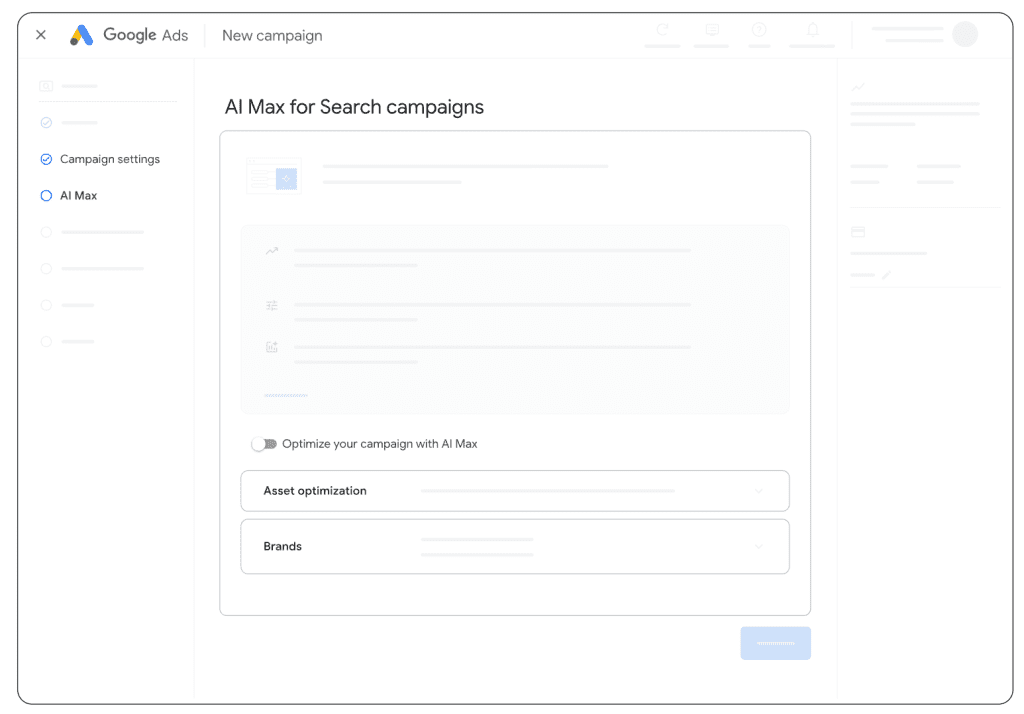
Google wants you to turn on AI Max for Search. If you’ve been in your Google Ads account recently, you have probably noticed the prompts, recommendations, nudges… It’s pretty hard to miss!
And if you’ve spoken to a Google Ads rep lately, they’ve almost certainly brought it up too. It is worth knowing that Google reps are incentivised to push AI Max adoption, which explains a lot. That doesn’t mean it is wrong for your account, but it does mean you should treat the recommendation with some scepticism rather than taking it at face value.
The pitch is compelling: broader reach, smarter creative, better performance… all with AI doing the heavy lifting so you don’t have to. But what actually happens when you switch it on? Well, we’ve been testing it across some of our PPC client accounts at The Digital Maze and, well…
The results are – to put it diplomatically – mixed.
What is AI Max for Search?
AI Max for Search is Google’s latest push to give its AI more control over your paid search campaigns. Here’s an overview of what it does:
Expands your keyword matching using AI to find relevant searches beyond what you have explicitly targeted
Generates and tests ad copy variations automatically
Works alongside Smart Bidding strategies like Target ROAS and Target CPA.
Think broad-match keywords, responsive search ads and dynamic search ads, but with the full power of AI behind them.
In theory, it finds customers you would have otherwise missed. In practice, it depends heavily on the account.
What Google Promises vs What We’ve Seen
Google says AI Max will improve performance over time as it gathers data. Our experience suggests it is less of a gradual improvement and more of an either/or situation. It works, or it doesn’t. Early performance is not always a reliable indicator of where it ends up.
On the creative side, it is genuinely interesting. AI generating and testing ad variations can give you combinations you wouldn’t have thought to try yourself. The problem is, you don’t always get a clear picture of what it is doing to your ads, which makes it difficult to learn from or replicate.
On Smart Bidding compatibility, Google positions AI Max as a natural fit with Target ROAS. However, in one of our accounts, performance actually deteriorated after pairing the two. Conversions picked up early and then stopped. The AI Max-specific match types barely contributed to revenue throughout. Most conversions came from exact match and close variants anyway, which raises a fair question:
Was AI Max actually driving those results, or was it just along for the ride?
Where AI Max Has Genuinely Delivered for Our Clients
One account did stand out. A B2B signage client saw significant revenue growth, a considerable increase in ROAS and the same number of conversions with around half the spend. Given how niche the audience is, this was probably our most surprising positive result. Data volumes are low, so it’s hard to draw firm conclusions, but it’s definitely a result worth noting.
A healthcare uniforms client showed strong revenue and ROAS improvements across two campaigns. But, when we dug into the data, the AI Max-specific match types had converted just once across both campaigns. The gains came from exact match and phrase match. So was AI Max responsible, or did it just… not get in the way? It is a question worth asking.
A windows, doors and conservatories client saw a 70% improvement in conversions on only 4% more spend, with CPA falling and conversion rate improving. All very encouraging on the face of it, right? But… it also started matching into brand terms, which inflated the numbers. So, a key learning here was that brand exclusions are essential before you switch this on. We also found lead quality suffered with this client, due to irrelevant search terms coming through, which brings us to the biggest problem – nuance.
Where AI Max Has Struggled
A craft supplies client is the clearest example of this.
Clicks increased significantly
Conversions dropped
CPA increased sharply
The search terms AI Max matched to were broadly related to the category, but missed the specific product entirely. AI Max found people interested in crafts, but it didn’t understand the difference between generalcrafts and this particularproducttype. That distinction matters enormously for conversion rate.
Some other clients where AI Max struggled:
A workwear and trades ecommerce client saw ROAS drop to well below the account average. Conversions picked up early then stopped completely, and it did not play well alongside Target ROAS bidding.
A luxury interiors client saw modest revenue improvement, but ROAS still sat well below the overall account average. Not a disaster, but not a particularly convincing result either.
A client specialising in loft conversions saw a modest drop in conversions and a rise in cost per conversion. Not the uplift that Google’s recommendations suggested was coming.
A second campaign for the windows, doors and conservatories client we mentioned above told a different story entirely. Conversions fell sharply, CPA rose and both clicks and spend dropped without any corresponding gain in efficiency.
So Should You Use AI Max for Search?
Based on our experience, that’s a genuinely hard question to answer yes or no to.
AI Max appears to work best in accounts with strong historical data, clean account structure and products or services that don’t rely on precise search intent. For niche products, highly specific services or accounts where lead quality matters as much as lead volume, the lack of nuance is a real risk.
It’s also worth noting that across several of our accounts, Performance Max is continuing to outperform AI Max for Search. If you’re already running Performance Max and seeing strong results, you should consider whether AI Max adds anything meaningful on top, or whether it just introduces more noise.
Don’t just turn it on because Google is recommending it, or because your rep is pushing it. Understand what it is doing in your specific account before you let it run.
We would love to hear from others who have been testing it. Are you seeing similar patterns? Different results entirely? Drop a comment or get in touch.
Not sure whether AI Max is right for your account?
At The Digital Maze, we review your campaign structure, bidding strategy, and account data before making any recommendations on AI features. If you want an honest second opinion, why not request a FREE account audit? No obligation and no sales pitch, just an objective review of your account
Emlyn is a PPC Team Lead with over 7 years of experience in PPC. Having worked both in-house and agency-side, he brings a well-rounded understanding of what clients really need and how to deliver it. At The Digital Maze, he leads a talented PPC team, shaping strategy and driving performance across a wide range of clients. Based in Stoke-on-Trent, Emlyn is a father of three and a big sports fan, often watching football or basketball. He also enjoys gaming and reading when he gets the chance.